Travelers/Trekkers are so curious about the high altitude of Annapurna Base Camp. It's that remarkable, and knowing how high it is helps in planning the trek to ensure it's the ideal journey for everyone. Let's get prepared for a massive trip!
Annapurna Base Camp is one of the most famous trekking destinations in Nepal. Its beauty, trek routes, magical Himalaya panoramas, various cultures, and biodiversity charm trekkers and nature lovers. However, the Annapurna Sanctuary trek is comfortable for all age groups.
The trek begins with a short drive from Pokhara to Nayapul. The starting point of the trek. Your trek starts at a lower altitude and gradually ascends to high elevations to reach the Annapurna Base Camp. The trekking route lies inside the ACAP (Annapurna Conservation Area Project) through the typical villages, forests, rivers, bridges, glaciers, and waterfalls. The trekking trail, you will pass the Bamboo, Dovan, Himalayan, and (M.B.C) Machhapuchhare Base Camp. The standard Annapurna Base Camp Trek takes around 10/12 days to complete.
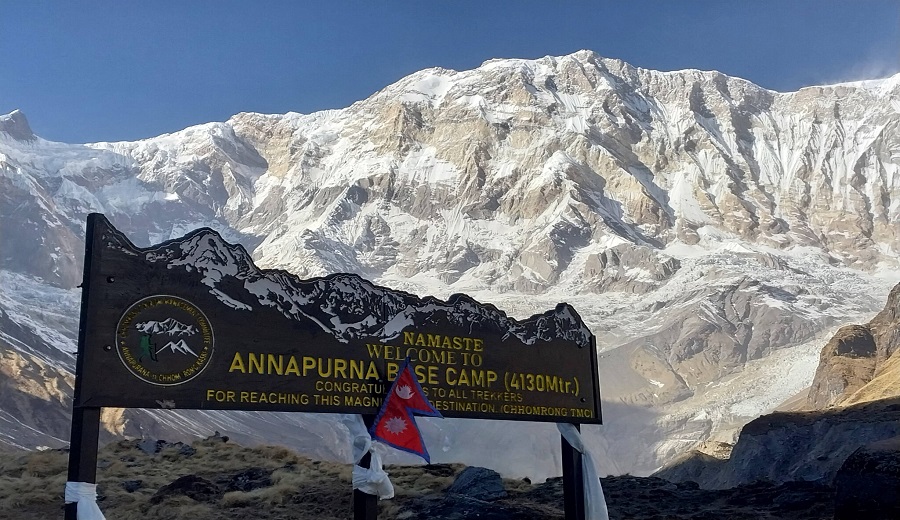
The ABC is (4,130 meters/13,549 feet) above sea level, and it is also the highest point of the trek. The Annapurna Base Camp offers breathtaking mountain panorama views of Annapurna I, Annapurna South, Hiuchuli, Gangapurna, and Machhapuchhare, and more. However, the high elevation makes it a demanding trek. So, you must know how high the Annapurna Base Camp is compared to the other treks. In this blog post, we will talk about everything you need to know about the high elevation of the Annapurna Base Camp.
Trip Highlights of Annapurna Base Camp
Have a look at the highlights of the Annapurna Base Camp Trip:
- Discover on the beautiful trip to the Annapurna region.
- Dip into the subtropical dense verdant of highland meadows.
- Experienced the rich biodiversity of the Annapurna Conservation Area.
- Hike to Poon Hill (3210 meters) for a breathtaking sunrise with Annapurna and Dhaulagiri ranges.
- Explore the Annapurna Base Camp (4130 meters).
- Beautiful mountain views of the Mt. Dhaulagiri, Tukche Peak, Nilgiri Himal, Annapurna South, Annapurna I, Hiunchuli, and Machhapuchhare, etc.
- Take a bath in the natural hot spring at Jhinu Danda.
How High is Annapurna Base Camp?
The ABC is below Mt. Annapurna, the world's tenth-highest mountain. The Annapurna Base Camp is at 4130 meters above sea level. It offers magical views of the Annapurna and Dhaulagiri ranges, etc.
Often, there is confusion about the Annapurna Base Camp and the Annapurna Circuit. But the trek takes you to a relatively lower elevation than the Annapurna Circuit. Moreover, the Annapurna Base Camp and the Annapurna Sanctuary have the same high elevation.
To give you a design of how high the ABC is, we will compare it with some of the other most famous mountain base camps:
- The world's highest mountain, Mt Everest Base Camp, is 5364 meters above sea level.
- Mt Kanchenjunga base camp is the world's third-highest mountain at 5143 meters.
- Along the route, trekkers will cross the Machhapurchhare Base Camp at 3700 meters.
Most important of all is knowing the Height of Annapurna Base Camp (ABC):
You know the high elevation of the Annapurna Base Camp is a main factor in the trek's difficulty and the high risk of altitude sickness. As you hike to a higher altitude, the oxygen level and air pressure change. This makes hiking more strenuous for travelers/trekkers.
Trekkers can assess their physical fitness condition and make preparations accordingly. They can also compare the high elevation of the ABC with other trekking destinations in Nepal. Likewise, you can make a plan for their schedule and acclimatization days that comforts you.
Knowing the height of the ABC also allows us to assess the weather and temperature conditions there. You can prepare proper and essential clothing and gear for the trip. Proper planning and preparation are needed to complete this journey. Hence, travellers need to know the high elevation of the Annapurna Base Camp before they plan their trip.
AMS – Acute Mountain Sickness:
Acute Mountain Sickness (AMS) or altitude sickness is one of the risks even when traveling at a high elevation. The region following getting AMS is that the body doesn’t change at the lower altitude, and the result can be boring. So, it is most important to take appropriate measures in a timely manner. Ahead of time, an altitude with a constant pace and good acclimatization days will help reduce the chances of getting AMS.
Likewise, you also have to keep yourself hydrated during the trip. As a result, drink a lot of water and keep away from alcoholic drinks as they dehydrate the body. If you are planning to travel on the local adventure journey of Nepal, then do keep it in mind.
Note: if you have any symptoms of altitude sickness, then keep contacting your local trekking guide. Our guide is trained, and he knows how to solve the (AMS) Acute mountain sickness.
The main Symptoms of altitude sickness:
- Headache
- Nausea
- Vomiting
- Fatigue
- Difficulty sleeping
- Dizziness
- Lightheadedness
- Loss of appetite
- Difficult to breathe
Preventive measures:
- Do not drink alcoholic beverages at high elevations
- Keep yourself hydrated
- Do they acclimate to a high altitude and then sleep at a low altitude?
- Do not achieve more than 500 meters in a day
- Do not walk very fast at high altitude.
- Walk slowly on the high elevations and keep walking.
- Do not walk alone on the way.
- Inform your guide as soon as you experience any high altitude sickness.
- Drink boiled water and hot tea.
- Take garlic soup and Ginger tea; it is a high-altitude sickness medicine.
Safety, Security, and Satisfaction:
Himalayan Local Guide guarantees our valuable clients (Safety, Security, and Satisfaction). Safety is the most important concern for us. For the trip, we will be carrying all necessary trekking gear, equipment, and kit boxes. Our professional leaders and local trekking guides have extensive experience and have wide first-aid training. When hiking on the way, if a trekker gets (AMS) – Acute Mountain Sickness due to the altitude, just normally: Headache, Vomiting, Dizziness, fatigue, or difficulty breathing, then you can share with our leader. Our local trekking guide leader will give you suggestions about AMS – Acute mountain sickness and how to medicate, and he /she can’t do anything other than trekkers must decide, will continue as health is most important. Just in case of an emergency, the rescue helicopter will always take you back to the hospital from a high elevation. No worries, we are always here for your services, and our time is always spent in the mountains with mountain lovers and hikers.
Best time for the Annapurna Base Camp:
March – April – May (Spring Season):
This is the best time to do the Annapurna Base Camp. The weather is good throughout the trek. Spectacular views of Mt. Dhaulagiri, Tukche Peak, Dhampus Peak, Nilgiri Himal, Annapurna South, Annapurna I, Tent Peak, Gangapurna, Hiuchuli, and Machhapuchhare, and many smaller white snow-capped mountains, etc.
The temperatures will be increasing from the middle of March, and with blue skies, white-snow capped peaks will be seen on occasion. So many Travelers often succeed in their climb at this time. On the way trip, the Nepalese National flowers will be in bloom; red, white, and pink colors with luscious green and dense forest.
June – July – August (Summer/Monsoon Season):
If you would like to do the Annapurna Base Camp Trek between June and August, it is the summer/Monsoon Season. The summer season falls in the months from the end of June to August. This time is the hottest and the rainfalls with a variety of vegetation blossoms during this season, the Valley will be green and have a better view than the spring and Autumn seasons. While you are going to travel, in the summer season, you have to be more careful with trekking trails, as they might be Muddy and Slippery. It will rain and be hottest during this season.
The temperature during the day will be 15 to 25°C, and it will get colder at night and in the morning. The temperature will be less than 8°C, and most of the morning will see blue sky with white snow-capped Mountains.
September – October – November (Autumn Season):
Another good time to do the Annapurna Base Camp. This season is the peak for trekkers due to the good weather conditions. As the monsoon season slowly ends, the best trekking climate sets in. The temperature will go up to 15 degrees in the daytime and, during the nighttime, will be down to 3 to 5 degrees. This time, travelers relax with natural views and culture. It is highly recommended as it is the best time to go for the Annapurna Base Camp Trek.
December – January – February (Winter Season):
The winter trek to Annapurna Base Camp is a famous season from March to May, September to October, and November. The places along the Annapurna Base Camp Trek will be cold during the winter season, but it will be an amazing trip. The temperature of the Annapurna Base Camp Trek can be as low as -10°C, which tempts travelers to visit this region. It might snow, and the Ground will be covered with snow on the trails.
The Coldest time Starts from December to early February, after overdue February, the Climate will slowly get warmer temperatures to get cold dropping to -2°C to - 5°C at high altitudes. When the sun comes up, the time gets warm, and the sky is filled with stunning Himalaya views.
Conclusion:
If you have any questions about how high the Annapurna Base Camp is, and the most important of all, knowing its height. You can make a plan for your Annapurna Base Camp Trek that is comfortable. Likewise, you can prepare yourself to physically and mentally tackle any obstacles during the trek. Now, you can understand the challenges of the journey.
Himalayan Local Guide Pvt. Ltd is one of the best local trekking agencies in Nepal, if you want to tour or trek in Nepal. We will do our best to arrange for you the best trekking experience. You can visit our website or directly contact us at info@himalayanlocalguide.com
FAQS
Is the Annapurna Base Camp suitable for beginners?
The Annapurna Base Camp is a moderate trek in the Annapurna region. It is ideal for beginner trekkers. Therefore, if you are physically fit, then you can do this trek. The Annapurna Base Camp is one of the best options for beginner trekkers.
What is the difficulty of the ABC?
The ABC trek is considered moderate in difficulty and requires good physical fitness. The trekking trails are physically and mentally demanding, as the trek includes uphills and downhills. Likewise, trekkers must walk 5/7 hours a day. This trek takes around 10 to 12 days to complete.
What types of permits are essential for the ABC Trek?
The ABC trek requires an ACAP (Annapurna Conservation Area Project) permit. Trekkers can obtain the permits through a government-registered trekking company in Kathmandu or Pokhara.
What kind of accommodations do I expect during the ABC Trek?
Along the trek route to Annapurna Base Camp, you will get tea houses, lodges, guest houses, and homestays. This trek offers basic facilities, including a cozy room with beds, blankets, and pillows. However, if you want extra services such as a hot shower, Wi-Fi, and battery charging devices. You have to pay additional costs.
Recent Post
Annapurna Circuit Trek with Ghorepani Poon Hill
30 July, 2026
Annapurna Sanctuary Trek Difficulty
08 July, 2026